
The ADHD Burnout Cycle: Why We Push Hard, Then Crash
Why ADHD brains don’t slow down until they crash and how to finally break the loop.

Hello ADHD Brains!
For most people, burnout is a “once in a while” thing.
For ADHD brains? It can feel like a lifestyle.
So this week, I had to take a page out of my own book.
Burnout is one of those things most of us with ADHD have just learned to accept.
We push ourselves to the edge because if we’re not exhausted, did we even work hard enough?
Then, when the crash hits, we shame ourselves for not being able to keep up.
We avoid, procrastinate, and spiral, because we’re still trying to fight our brains instead of working with them.
This week was my wake-up call.
I found myself doing all the things I tell you not to do — working 10–12 hour days on my computer, skipping real breaks, and when I did stop, I wasn’t actually resting.
I was doom-scrolling, overexerting myself and binging sugar instead of doing something that would actually recharge me, like a walk, eating high protein foods or catching up with a close trusted friend.
The truth is, most of us are living our lives on this same loop.
We live in this loop:
Hyperfocus → overcommit → crash/burnout → guilt/shame → restart.
Sound familiar?
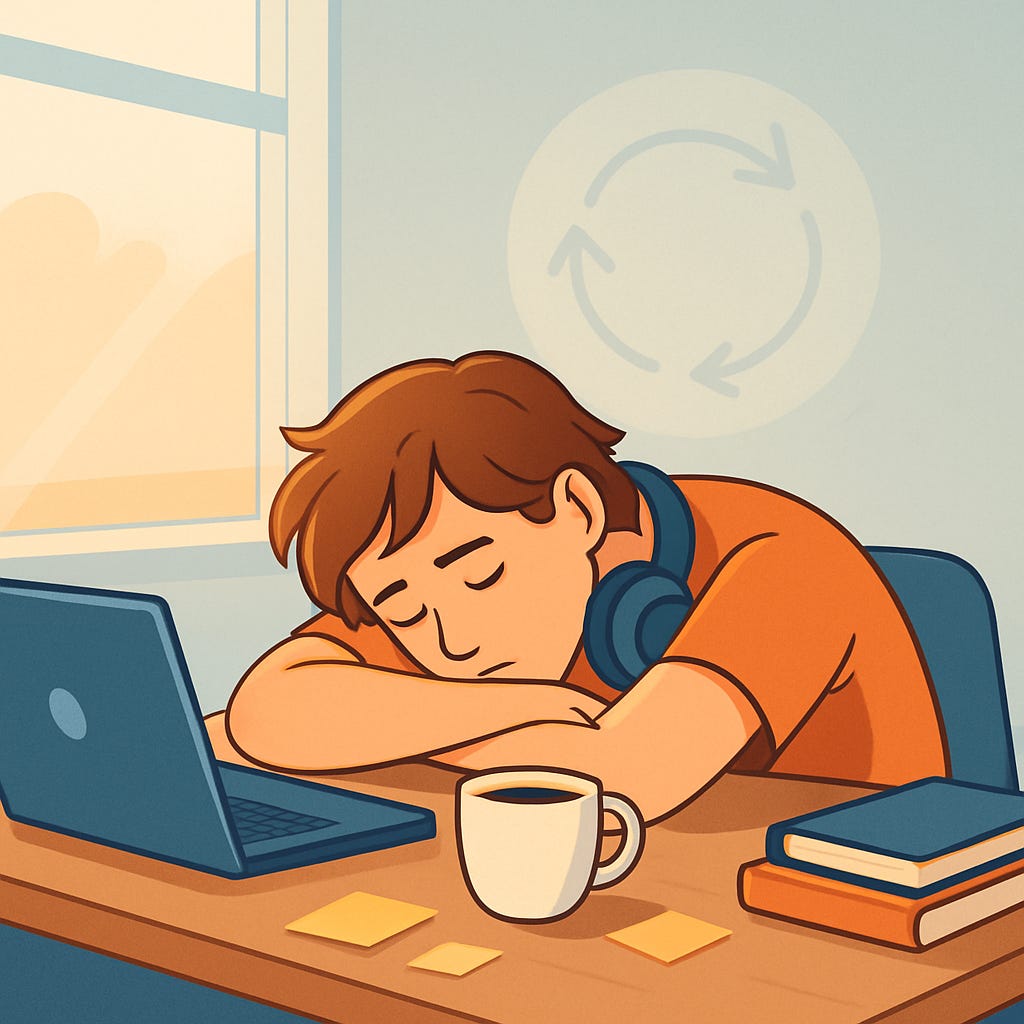
Why ADHD Burnout Feels Different
When people say “burnout,” they usually mean stress at work or being tired after a busy season.
For ADHD brains, burnout cuts deeper. It doesn’t just leave you tired — it leaves you offline, disconnected and quite frankly dead to our souls (dramatic, but is it really?).
Brain fog: Simple tasks feel impossible. You can’t focus, plan, or even decide what to eat.
Body crash: One day you’re buzzing with energy, saying yes to everything, the next you’re in bed, wiped out.
Emotional crash: You feel heavy, irritable, or numb. Sometimes you lash out, sometimes you shut down completely.
And the worst part?
It sneaks up on us. We don’t notice we’re in burnout until we’re already there.
Why ADHD Brains Burn Out So Easily
Here’s the thing: ADHD isn’t just about attention. It’s also about energy regulation.
Think of it like this, we act like we’ve got unlimited fuel. We keep the pedal down, pushing through every warning light because slowing down feels wrong.
We’re basically “cars” running on empty, pretending we can make it “just a little further.”
And the further you drive on no fuel, the more damage you do to the engine. It’s the same with us!
The longer we ignore rest, the more we quietly wear ourselves down until the crash isn’t optional anymore. (Its forced on us just how a car breaking down happens when we don’t do maintenance)
Also our brains are wired to chase stimulation (Dopamine essentially) — new projects, new goals, that hit of dopamine when we get something done.
But pacing ourselves?
Taking breaks before we need them?
Resting when things are going well?
That feels boring. Painful, even.
We panic, we think “Well if i don’t keep going then I wont get it finished, I need to use all my fuel now!”
So instead, we sprint until the tank is empty.
Then wonder why we’re lying on the couch, staring at the ceiling, avoiding texts and emails like they’re landmines.
NOT TO MENTION
The guilt and shame that come associated with it.
The Cycle in Action
Here’s how the loop usually plays out (see if this sounds familiar):
The Sprint – You feel unstoppable. You say yes to everything, pile up tasks, start new projects, and ride the high of hyperfocus.
(Example: “I can totally finish this big work project, meal prep, start a new hobby, AND clean the house all in one day!”)
The Crash – Suddenly, you hit the wall. Exhaustion sets in. You avoid tasks, ghost friends, and binge Netflix or doom-scroll TikTok just to cope. (Searching for any bit of instant dopamine to refill that tank)
The Guilt – Now shame creeps in. “Why can’t I keep it going? What’s wrong with me? Everyone else seems fine.”
The Restart – Eventually, you drag yourself back up… usually by diving into another sprint.
The cycle repeats.
How living in the Loop would burn me out for months.
I used to live in this burnout cycle constantly.
I’d grind 12–15 hour days, working in the morning at a job I hated. Then bouncing between the gym (Doing exercise is good, but I was doing exercises I hated.) , pumping out ADHD content, and filming videos like my life depended on it.
Now just to pause, I will say there is moments where going all or nothing can have there benefits but when we push ourselves to the extreme levels of exhaustion on a consistent bases, well there is going to be consequences.
And guess what? There was consequences
It worked — until it didn’t.
Because after those insane sprints, I’d collapse.
Weeks/Months of burnout.
No energy to post, no motivation to train, no capacity to even reply to messages.
All that progress for what?
My gym progress would be halted, losing gains and strength.
My job i hated but was paying the bills - Well i was fired, turns out you cant call in sick everyday with a cold. (for 2+ months) Bummer..
My workflow interrupted/killed. Building up this consistent daily posting schedule to just abandoning it after weeks/months. (Due to being so burnout)
It wasn’t laziness. It was my ADHD brain running on fumes until the crash was unavoidable.
Why This Isn’t Laziness
Let me hammer this home: For the ones who cant seem to accept that we need to rest sometimes. (Cough, cough. ME)
Burnout doesn’t happen because you’re weak.
It happens because your ADHD brain runs on a “feast or famine” fuel system.
We chase dopamine → we overexert → we crash → we blame ourselves.
Neurotypicals can coast on steady energy.
ADHD brains?
Well, we floor it until the engine overheats.
Even God Himself rested on the seventh day (Genesis 2:2). And this is God?
I MEAN IF THAT MAN RESTED WHY CANT WE?
Rest isn’t weakness — it’s wisdom.
It’s understanding our brain and learning to work with it.
A Quick Way to Ease the Cycle
Here’s one tool from the premium post you can try right now:
Build in micro-breaks before your brain forces a crash.
That means stopping before you’re cooked — even if you feel like you could keep going.
For example.
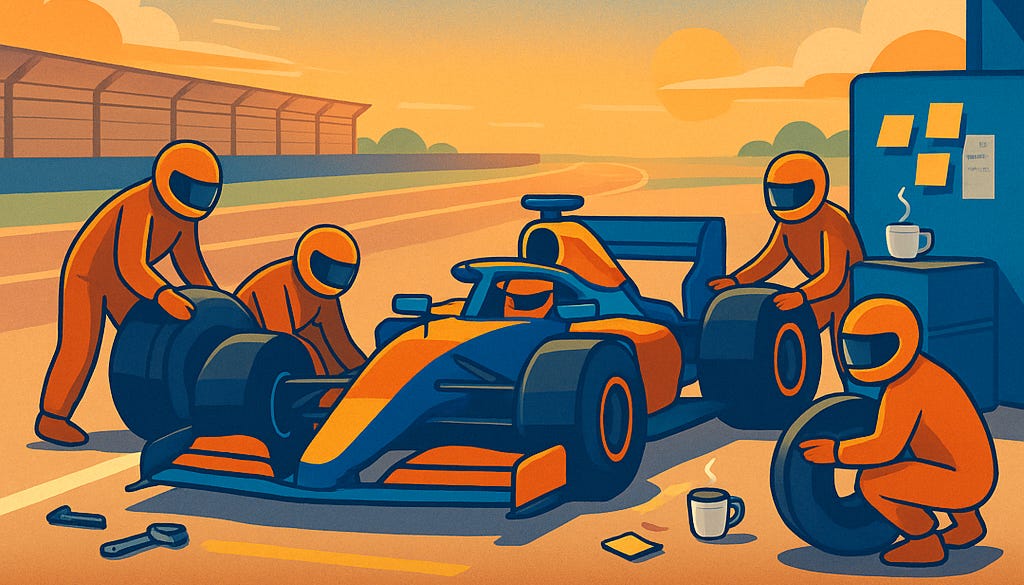
Think of an F1 car. They have pit stops for a reason.
Even the fastest cars in the world can’t run full speed lap after lap without pulling in to refuel, change tyres, and cool down.
Not because they’re weak — but because that’s how they win the race.
Our ADHD brains are the same.
We run hot, fast, and full of intensity — but if we don’t stop for short, intentional breaks, we don’t make it to the finish line. We crash.
Those micro-breaks, a 5-minute walk, a stretch, a drink of water, aren’t slowing you down.
They’re your pit stops. The thing that keeps you in the race.
So please try the following.
Set a timer: after 45 minutes, stretch or grab water. (Even a 5 min interval/break can stop a burnout/crash)
Stack habits: finish one task, then reward yourself with a 5-min walk or snack/or YouTube video. (make sure its longform 5-10 minute video not short form content)
Switch gears: when deep work fries your brain, shift to something lighter (Quick reset of your desk, reply to a quick text).
It feels counterintuitive. “I don’t have time to stop.”
But here’s the paradox: tiny pauses actually keep your fuel tank from hitting empty.
Want the Full System?
The ADHD Burnout Reset Toolkit.
Here’s what’s waiting inside this week’s premium post:
✅ The 3 stages of burnout and how to spot them early + quick fixes
✅ My ADHD Burnout Reset Ritual (10 minutes, step-by-step)
✅ A printable Burnout Reset Flowchart to keep the roadmap in front of you
Because you don’t have to keep living in this loop.
→ That’s all inside the Premium version of this post.
Unlock it now by clicking subscribe below. 👇
[Upgrade to a paid subscription here to get the toolkit + all past and future premium posts]
Final Thoughts
Burnout doesn’t mean you’re broken.
It means your brain’s been running a marathon without any water stops.
You can’t avoid ADHD burnout forever — but you can catch the signs earlier, pace yourself better, and reset faster when it hits.
And the more you practice, the more you’ll realize: you don’t need to burn it all down just to get a rest.
You deserve rest.
You deserve grace.
You deserve to feel valued without “proving” your value.
Yes some days going 100% is needed and is honestly okay, but we cant live our life’s like this all the time. Its just not healthy or feasible.
Like I always say, treat yourself how you would your best friend.
For example you would not advise your best mate to go all in 120% everyday, you would be kind and explain the importance of slowing down.
💌 So If you found value in todays newsletter and want more ADHD tips and motivation straight to your inbox? Hit subscribe ITS FREE! to stay in the loop with strategies designed for ADHD minds.
Faith Anchor
When I think about rest, I’m reminded of Psalm 62:1–2:
“Truly my soul finds rest in God; my salvation comes from Him.
Truly He is my rock and my salvation; He is my fortress, I will never be shaken.”
For most of my life, I thought rest was something I had to earn.
That once I worked hard enough, proved enough, or achieved enough — then I could rest.
But this verse reminds me that real rest doesn’t come from checking things off a list.
It comes from letting go — from knowing that I’m safe, covered, and cared for by God.
Because when we rest in Him, we’re not falling behind.
We’re refueling with the One who never runs out of strength.
Question for You?
Be honest with me
What’s the hardest part about letting yourself rest without guilt?
Is it the fear of falling behind? Feeling lazy? Or just not knowing how to actually rest when your brain never switches off?
For me personally, it’s that feeling that if I’m not producing or operating at 100%, I’m somehow failing.
I think a lot of that comes from being called “lazy” as a kid.
Even when I wanted to do things, or thought about doing them — I just couldn’t follow through.
And now, as an adult, I’ve carried that with me and turned it into this identity of being a “hard worker,” like I have to constantly prove myself.
But lately, as I’ve started actually applying what I’m teaching in this week’s premium post, I’ve been learning to let go. To rest.
And to realize that slowing down doesn’t mean I’ve lost my drive — it means I’m finally working with my brain, not against it.
Drop it in the comments below, I’d love to hear your experience.
You never know who might need to hear they’re not the only one.
Thanks for reading,
Kind Regards
Luke
ADHDInsights
P.S. Every time you share these posts, you help another ADHDer feel less alone. So if you thought of someone while reading this, go ahead and pass it on.
Funny I've just recently recognized this cycle and am literally coming back to life after a crash as we speak lol. But this time I really took stock of the warning signs. Because my body started throwing up red flags about a week before the night I crashed out hours earlier than usual and woke up 2 hours later feeling like a storm was raging inside my body. Temperature dysregulation, upset stomach, weird throbbing pains in weird places. It was awful. And a whole new kind of crash I've never experienced (as I age my nervous system seems to be getting more and more dramatic and does some wild ass things).
Well my focus was the first thing to go, I was definitely struggling last week and should have seen it and slowed down instead of pushing harder. Another red flag I noticed this morning when I got up ready to go back into action, for the last few days I've been able to walk past things that shouldnt be on the floor (socks, trash, etc.) without picking them up. So this morning, when without thinking, I started picking it up I was like "AH HAH! GREEN FLAG!!!"
So yeah, what I'm saying is watch out for the signs. Stop the crash before it happens! To apply your driving metaphor, quit blowing through red lights!
Have you tried the pomodoro trick? It's 25 on 5 off but I do even less some days ...15 on and 3 off; just breathing with a weighted blanket and an ice pack. I get overheated very easily with my sensitivity to sensory input. Brain is racing and body is aching.